Core skill
Gun elevation and powder charges
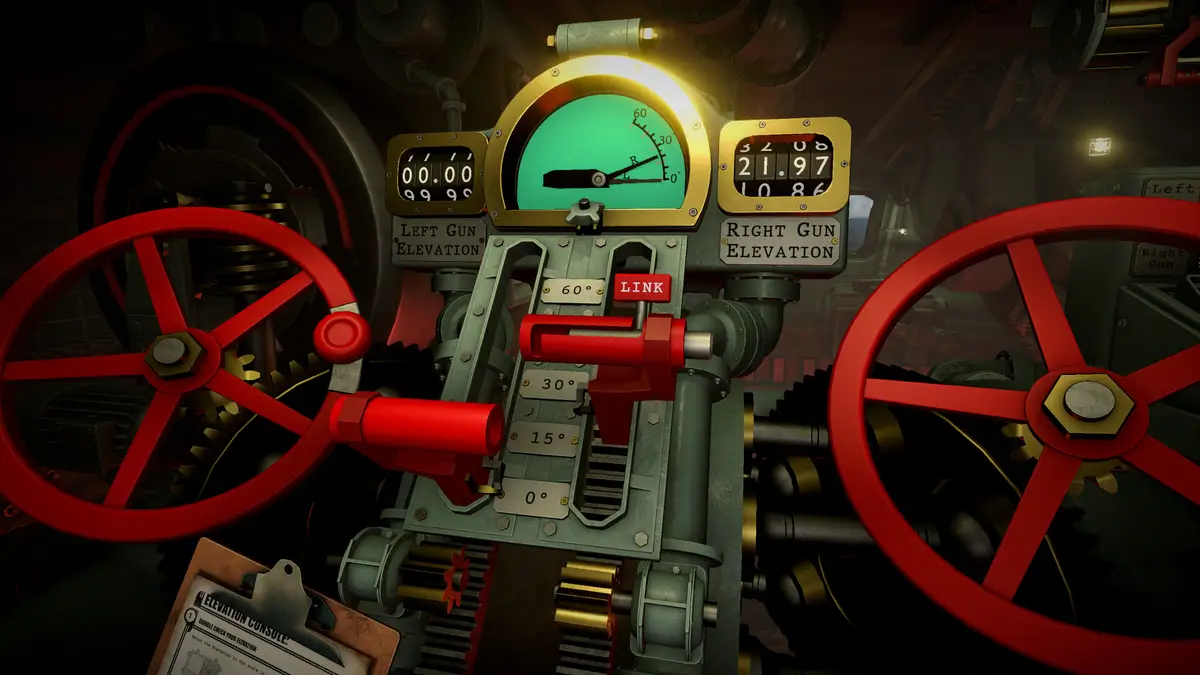
Charges decide how far the gun can throw. Elevation decides where inside that envelope the shell actually lands. Both come out of one line of arithmetic.
The formula
elevation = (range ÷ (charges × 5000 m)) × 60°
IRON NEST does not simulate a ballistic arc you have to solve numerically. Range scales linearly with elevation up to the maximum, which means the relationship is a plain proportion. That is unusual for an artillery sim and it is good news: you can do this in your head between rounds.
Read it as: 60° is always maximum range for whatever is loaded.Half the elevation is half the range. A target at 60% of your maximum range needs 60% of 60°.
The charge table
Every powder charge you ram adds 5 km of maximum range and costs 4 requisition points. The multiplier column is the shortcut: take the range in kilometres, multiply, and you have the elevation in degrees without touching a calculator.
| Charges | Max range | Requisition | Elevation shortcut | Check |
|---|---|---|---|---|
| 1 | 5 km | 4 | km × 12 | 5 km × 12 = 60° |
| 2 | 10 km | 8 | km × 6 | 10 km × 6 = 60° |
| 3 | 15 km | 12 | km × 4 | 15 km × 4 = 60° |
| 4 | 20 km | 16 | km × 3 | 20 km × 3 = 60° |
| 5 | 25 km | 20 | km × 2.4 | 25 km × 2.4 = 60° |
| 6 | 30 km | 24 | km × 2 | 30 km × 2 = 60° |
Memorise the three-charge row. Three charges reach 15 km, which covers most of the campaign, and its multiplier is exactly 4 — the easiest mental arithmetic on the table. A target at 7.3 km on three charges is 7.3 × 4 = 29.2°.
Need it worked out for a specific range, including every alternative charge count?The calculator does it live.
Choosing a charge count
The minimum charge count is the range divided by 5 km, rounded up. Every count above that also reaches. They differ in three ways that matter:
Fewer charges
Cheaper, and a steeper arc. Steep is what you want to clear a ridge line or drop rounds into a gorge where a flat trajectory would hit the wall.
More charges
Flatter and faster. Shorter flight time is worth requisition when the target is moving, or when a fire mission is on a timer and you cannot afford a shell in the air.
Headroom
Above about 55° you are at the edge of that charge's envelope. If the spotter comes back with "add 400", you may not be able to reach without unloading and re-ramming.
Why 60° and not 45°
Real artillery reaches maximum range near 45°; beyond that, range falls off again. IRON NEST does not work that way, and the developers have been open about why. In the official FAQ they explain that an early research error about the Schwerer Gustav's elevation capability put the maximum at 60°, the entire fire-control system was designed around that figure, and by the time the mistake surfaced a redesign was not realistic for a two-person team.
Practically: do not bring real-world ballistic intuition to this gun. There is no second solution at high angle, no drop-off past 45°, and no reason to prefer one elevation over another except arc shape and correction headroom.
The loading sequence
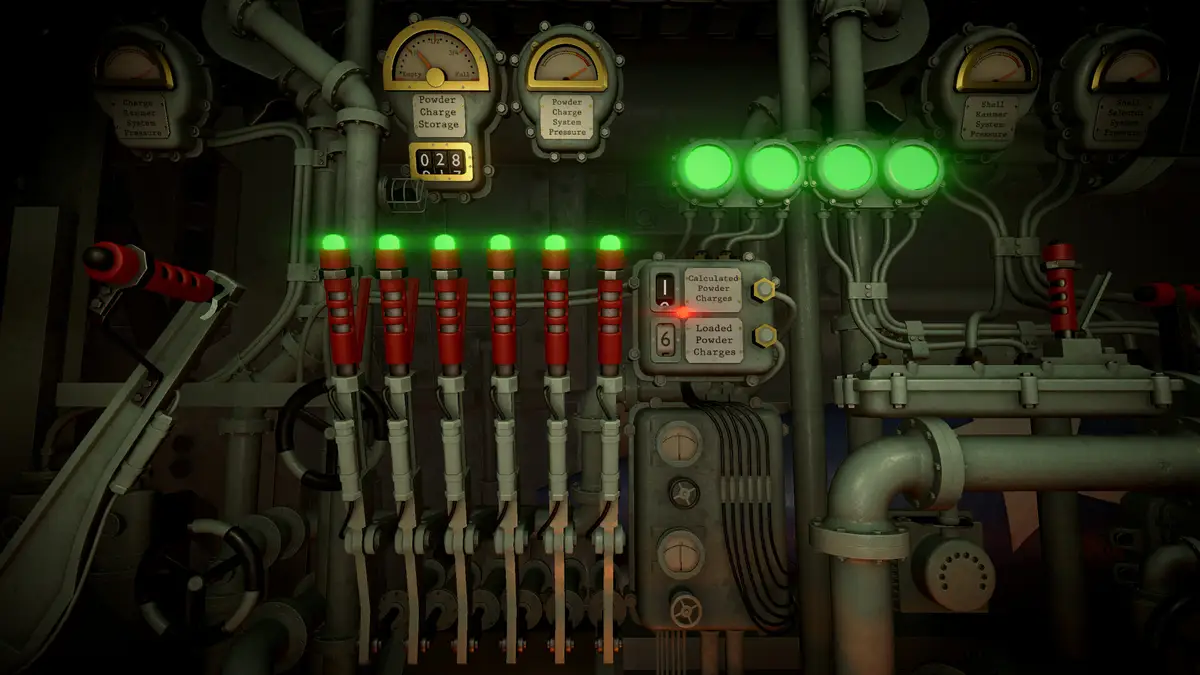
Charges are physical. You ram them, and the number you rammed is the number the gun has — there is no in-flight adjustment and no way to check by looking at the readout what you put in. Count as you load.
- Ammunition is staged in two shell cylinders at the back of the turret, giving a ready supply of twelve rounds. Anything past that sits outside on logistics trucks and takes real time to bring in.
- Turret traverse has two controls: a lever that is fast but imprecise, and a wheel that is slow but exact. Standard practice is lever onto the rough bearing, wheel for the last degree.
- There are two separate elevation levers, so the two barrels can sit at different elevations. Two targets on the same bearing at different ranges can therefore be engaged without re-laying.
Where the requisition goes
At 4 points per charge, a six-charge shot costs 24 points in propellant before you have paid for the shell. You earn requisition by destroying priority targets — the ones flagged with a star marker — at 10 points each, and Challenge Mode starts you with 100. Points do not carry between sessions.
This is the real argument for using the minimum charge that reaches: over a long mission, the difference between habitually firing four charges and habitually firing the minimum is several recon flights you could otherwise have bought. Recon planes are expensive, and the requisition has to come from somewhere.
Next
Sources
- Community guide — An operator's guide to the basics — Player-written reference for the grid system, marking tools and charge/elevation maths.
- Official FAQ thread, Steam Community — Maintained by the developers. First-party answers on platforms, pricing, multiplayer, VR and design intent.
Last updated .